
Conventional wisdom in the game of Survivor is an ever-evolving organism, much like the format of the game itself. The two ideas feed on one another; as fast as players begin to develop optimal strategies, the need to keep things fresh and keep ratings high spurs changes to the twists that are thrown at the players. We see this as far back as Season 3: Africa. The novelty of watching strangers work together to build a new society in the jungle had started to wear off and producers introduced the first real twist to the format of the game: the tribe swap. Richard Hatch established the first iteration of conventional wisdom for the game in Survivor: Borneo by creating an alliance and using that bond of trust to carry the alliance to the end of the game, eventually netting himself the win and a million dollars.
The Ogakor Tribe in the second season of Survivor: The Australian Outback perfected this conventional wisdom. After entering the merge tied 5-5 in numbers against the Kucha Tribe and winning the previous-votes-against tiebreaker at the first merge tribal council, the Ogakor Tribe never lost their numbers advantage again, slowly picking off their own tribe members only when doing so allowed them to maintain a majority Ogakor against the remaining Kucha minority. The final 3 of the season all came from the tribe that won out in the merge vote because short of an individual immunity run there was nothing that the Kucha Tribe could do about it.
Producers realized that viewers would eventually tire of seeing which tribe won out with the numbers advantage heading into a merge, likely resulting in someone from the majority winning the season. The tribe swap offered the opportunity for players to have mixed relationships before they entered the individual portion of the game, muddying the waters that previously had offered a relatively clear path forward. At the end of the day that’s all that any twist is: a way to make sure that a fool-proof plan doesn’t remain fool-proof.
Hidden Immunity Idols allowed players on the bottom a way out and players responded by splitting the majority vote to ensure the majority stayed intact. In Season 37: David vs Goliath we saw a further evolution of this strategy when the David Tribe split their minority vote while correctly playing an idol in anticipation of the Goliath Tribe majority also correctly playing an idol, resulting in The Mayor of Slamtown being double-idoled out of the majority. In the very same season we saw Dan play an idol to save himself only to be sent packing when a new twist was introduced in the Idol Nullifier. When players begin to crack the code then producers, by necessity, change the code.
While it’s true that conventional wisdom in Survivor is constantly changing, I think there is one bit of wisdom that has held true, and will continue to hold true in perpetuity. Unfortunately it comes from one of Survivor’s most unscrupulous winners: Survivor: Thailand’s Brian Heidik. He articulated a strategy that involved being in as many majorities as possible. In the context of Survivor this can include many different categories but the easiest ones to see are tribal majorities, gender majorities, and ethnic majorities, the latter being easy for Brian to come by as a white male, particularly in the earlier seasons of the show. Not all of these majorities will end up mattering or being impactful to the outcome of a season but it is the one piece of conventional wisdom that Survivor producers cannot change the code for. A majority will always matter, even if it’s not the current majority. Having another group to pivot to if the current majority implodes will always have value. True mastery of this piece of wisdom is the ability to be covered on all sides for the duration of a season while ensuring that no one else catches on to your insulation until they’re voting for you to win at the Final Tribal Council.
A few years ago I played an ORG (Online Reality Game) where each player on the cast secretly chose a character from the Shrek franchise, created a social media profile based around that character, and then played Survivor as those characters. One of the things that the Shrek franchise taught us is that ogres are like onions; they have layers. I think this is a beautiful analogy for the type of insulation that I’m referencing above. A master of this type of conventional wisdom will have layers of alliances built around them, ready to be peeled away when the time is right and not a moment too soon.
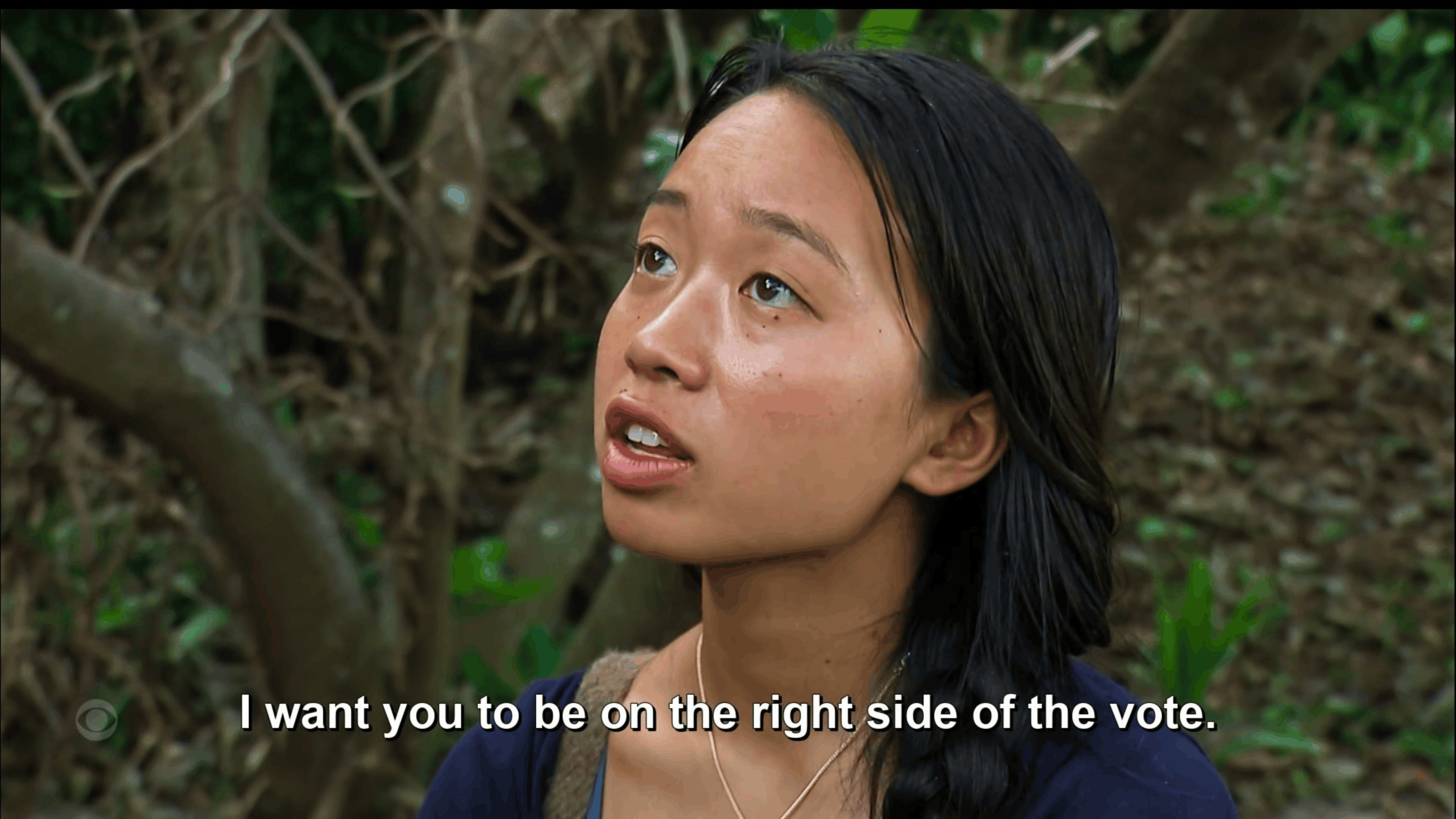
I think one of the best ways to achieve that type of insulation is with X-1 votes, particularly in the early game. Unanimous votes create a sense of unity and give everyone at least some initial level of comfort that the people going back to camp with them will all do what they say they will do and are willing to make compromises for the larger group at this stage of the game. That’s why I was completely baffled to see both the Toka Tribe and the Savu Tribe have consensus votes on the table, in Jenna and Eric respectively, and end up with a 6-2 (due to Jenna and Aaliyah both playing their Shot in the Dark) and 6-4 vote at their first Tribal Councils of the season.
The players don’t know that a tribe swap is right around the corner, but I think that it’s a safe bet to assume as a player that the tribes will mix in some fashion. It feels unlikely that producers would put the entire cast onto the same beach on Day 1 just to leave them completely isolated from each other until the merge. Even knowing that half of the New Era seasons didn’t have a tribe swap, it’s something that players should be making contingencies for. Knowingly burning bridges with players that will be left in the game after a blindside is often a necessary part of Survivor, but doing it so early is risky business.
The Toka Tribe has now done this at both Tribal Councils that they’ve attended so far. The first vote of the season left Devin and Jelly out of the majority. They were able to reintegrate into a voting block of 5 but were still left out of the majority vote again when a coalition of 6 formed against them, now with Brady and Mike joining them in the minority. From a viewer’s perspective I see more potential risks than benefits in these types of votes, unless you are Jenna or Kilby. It takes continuous effort to build trust in a game where trust is currency and only a single vote to break it. Going into a potential tribe swap with people who know that you are willing to move against their plans limits opportunities rather than creating them. Jelly, Devin, Mike, and Brady now all have a reason to break up a potential Toka majority on a swap tribe because members of the Savu Tribe haven’t yet had a chance to vote against them in the way that Thien An, Kilby, Maggie, Jenna, Lewis, and Carter already have.
The Savu Tribe would be in the same boat as the Toka Tribe had Rob not been in imminent mortal danger and had Carter not missed the boat and “accidentally” ended up mutinying. Intentionally blindsiding Ana, and leaving Carter and Rob completely out of the loop, would have left the Savu majority with less opportunities during a potential tribe swap. As it stands for them now Carter is the only person they’ve burned a bridge with who is left in the game and Carter has already managed to burn bridges with half of his new tribemates by blindsiding them at Tribal Council so the unconventional move potentially has fewer repercussions for them. However, the conventional wisdom of a unanimous Eric boot will hang in the back of my mind as the season progresses.
The real question to me is why the cast of Survivor 51 seems to be so comfortable making these unconventional moves in a game where having options creates opportunities. I think Jeff Probst and the production team have done a good job of painting the game as a monster that can devour the players. When the format is full of so much unpredictability it can feel a bit silly as a player to try and stick to conventional wisdom if you know that part of a producer’s job is to throw twists at you for ratings. Ironically, I think the unpredictability increases the value of having options available to you because the format often puts the players in small groups at random times, increasing the likelihood that a burnt bridge could end your game.
I’ve always said that there’s no such thing as a “right” or “wrong” move in Survivor, just moves that end up working and moves that don’t. Unless Jenna or Eric end up winning the season then the “unconventional” moves made during the first few votes of the season will end up being the move that worked out for someone. I will say that I’ve been enjoying the unconventional strategies that we’ve seen so far. It makes for exciting television (boring gameplay is “good” gameplay). Tribe swaps usually provide a wealth of new relationships and I expect that to be exacerbated by the amount of relationships that we’ve already seen fractured. The players and the producers both collectively muddying the waters has the potential to make for a very unpredictable finish.